
Bridge or implant? Here’s what actually matters.
A dental bridge and an implant both replace a missing tooth. They work differently, cost differently, and have different long-term effects on your jawbone and neighboring teeth. Here’s an honest look at both.
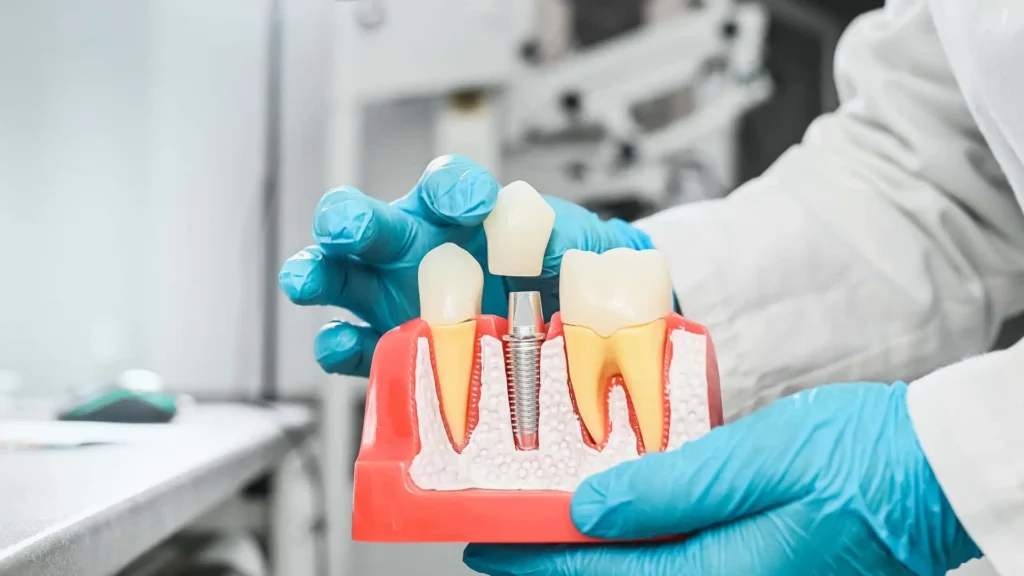
What are the key differences between a bridge and an implant?
A dental bridge and a dental implant are both restorative care options for a missing tooth, and we place both at our Las Vegas office, so whichever fits your situation, the same team handles it. Here’s how they compare:
| Factor | Dental bridge | Dental implant |
|---|---|---|
| How it works | Prosthetic tooth anchored by crowns on the neighboring teeth | Titanium post placed in the jawbone, with a crown on top |
| Adjacent teeth affected | Yes — neighboring teeth are shaped down and crowned | No — the implant stands on its own |
| Jawbone preservation | No — bone gradually resorbs under the gap | Yes — the post stimulates and preserves the bone |
| Upfront cost | Quoted after your exam | Quoted after your exam |
| Typical lifespan | 10–15 years | Post: designed to last decades. Crown: 10–25 years |
| Maintenance | Floss threader needed to clean under the bridge | Brush and floss normally |
| Timeline | 2 visits over 1–2 weeks | Several months, with healing time between stages |
| Candidacy | Fits most patients with healthy adjacent teeth | Needs adequate jawbone density; we confirm this at your consultation |
When is a bridge the right call?
Bone loss has already occurred. An implant requires adequate jawbone to anchor the post. If significant bone loss has happened since the tooth was lost, a bridge may be the more realistic path, or a bone graft would be required before an implant, adding time and cost.
Cost is the deciding factor. Bridges have a lower upfront cost than implants, and PPO plans often cover a portion. For some patients, a bridge is the right choice simply because it’s what works financially right now.
Speed matters. A bridge typically takes two visits over one to two weeks. An implant involves a healing period of several months. If you need a solution quickly, a bridge gets there faster.
The neighboring teeth need crowns anyway. If the teeth on either side of the gap already need crowns for other reasons, a bridge leverages that work rather than adding a separate implant procedure.
When is an implant worth the investment?
You want to preserve your jawbone. This is the most important and least-known difference between the two options. When a tooth is missing and there’s no root in the bone, the bone gradually resorbs. Over years, this can change the shape of your jaw and affect neighboring teeth. An implant post acts like a root and keeps the bone stimulated. A bridge doesn’t.
You’d rather not affect healthy neighboring teeth. Getting a bridge means the teeth on either side of the gap are permanently shaped down to accept anchor crowns, even if those teeth were in good shape before. An implant requires no modification to surrounding teeth.
You want the longest-lasting solution. Implant posts, once integrated with the bone, are designed to last for decades. The crown on top needs replacement eventually, typically after 15 to 25 years, but the foundation is built to stay put.
You’re thinking long-term. The upfront cost of an implant is higher, but over a 20-year window, it often compares favorably to replacing a bridge one or more times.
Not sure which is right for your situation?
That’s exactly what a consultation is for. Your dentist looks at the actual condition of the bone, the health of the neighboring teeth, and your overall picture, and tells you which option makes sense and why. You’ll leave with a clear recommendation and the reasoning behind it, and you decide on your own timeline.
What it costs at Hollywood Smile Dental
Every treatment starts with a written estimate, so you know the cost before anything begins.
What to expect
- Cost Quoted after your exam
- 20% on both
Book a visit
No rush. No judgment. No surprises.
Common questions
Everything you need to know before your first visit.
Is a bridge or implant better?
Neither is universally better. They’re different solutions with real trade-offs. Implants preserve bone and leave the neighboring teeth untouched. Bridges are faster, less invasive upfront, and cost less. The right answer depends on your bone health, the condition of the adjacent teeth, your timeline, and your budget.
What’s the cost difference between a bridge and an implant?
Bridges have a lower upfront cost. Implants cost more initially but may be more cost-effective over 20+ years if you factor in bridge replacement. Both may be partially covered by PPO plans, bridges are often covered under major restorative coverage, and implant coverage varies by plan. We verify your benefits at your consultation.
Does an implant hurt more than a bridge?
Both procedures use local anesthetic. Implant surgery involves a healing period that a bridge doesn’t. Discomfort varies by person, but most patients report the experience was more manageable than they expected.
Can I get an implant after having a bridge?
In many cases, yes, but it depends on bone levels at the time and whether a bone graft is needed. We assess this at your consultation.
What if I can’t get an implant right now but want one later?
Starting with a bridge is a reasonable path for some patients. The key is preserving the option by maintaining good oral health. We’ll discuss what that looks like at your visit.

Bridge vs. implant questions
The facts favor different options for different situations. A short consultation puts both paths on the table with your specific numbers and your actual bone and tooth health in the picture.
Book a visit
No rush. No judgment. No surprises.